You smash churches while we rob you blind
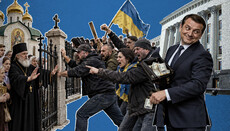
Some numbers need no commentary – you only have to put them side by side. 3,725 hryvnias and 390,000 hryvnias.
The first is the minimum pension of a Ukrainian who spent forty years working in a factory, a school, or a hospital.
The second is the highest pension paid to a retired judge. It is not a reward for heroism, not a prize for an invention, not even a token of gratitude for lives saved. It is simply a pension. Just like the one a doctor, teacher, or factory worker receives. Except it isn’t. The difference is 105-fold. The gap between the average pension of an “ordinary” Ukrainian and that of a judge is smaller, but still staggering – fifteenfold. Other members of the privileged caste are hardly struggling either. According to Danylo Hetmantsev, head of the Ukrainian parliament’s finance committee, prosecutors can receive pensions of up to 219,000 hryvnias, while former lawmakers can get as much as 245,900.
Meanwhile, the country’s largest group of pensioners – around 2.4 million people, one in every four – receives between 3,000 and 4,000 hryvnias a month.
Why does the state treat its citizens so differently? Why does Ukraine have first-, second-, and even third-class citizens? And if that is the case, what does the state have the right to demand from those it has relegated to third class?
Find one clean government agency
There is a law no one ever wrote down, but everyone knows it: stealing is wrong, and stealing during a war is vile. Ukraine lives as though that law does not exist. Try naming a government agency where nobody steals. Not under Kuchma. Not under Yanukovych. Today – in the fifth year of the full-scale war.
In 2023, the entire country was outraged by Defense Ministry procurement contracts in which food for soldiers was bought at fantastical prices – most famously the notorious “17-hryvnia eggs.” At the time, it looked like a one-off disgrace from the ministry under Oleksii Reznikov. A year and a half later, NABU and SAPO put a price tag on it: officials made 733 million hryvnias off food intended for the army.
And let us be clear – this was money stolen from the defenders of the country, the same people Ukrainians nationwide were donating to support.
Then it got worse. On the so-called “Mindich tapes,” recorded in a businessman’s apartment, Defense Minister Rustem Umerov discusses the sale of a one-third stake in arms manufacturer Fire Point for $600 million, half of which was allegedly supposed to go to the “shareholders in cash.” Umerov was never named a suspect – he is a witness in the case and now serves as secretary of the National Security and Defense Council.
They steal in the government. Oleksii Chernyshov, deputy prime minister and minister of national unity, was served with a notice of suspicion while still in office. In the “Midas” case, investigators allege that in 2025 alone he accepted more than $1.2 million in cash on three separate occasions.
They steal in the Energy Ministry. Herman Halushchenko, who ran the sector for four years, was named a suspect in the “Midas” case on charges of money laundering and participation in a criminal organization. Investigators put the total losses in the case at $100 million. According to NABU, Halushchenko personally funneled more than $7.4 million into accounts belonging to a foundation registered to his family, along with 1.3 million Swiss francs and €2.4 million – including money used to pay for his children’s education in Switzerland. His successor, Svitlana Hrynchuk, lasted two months in the job and stepped down after her name surfaced in the same Energoatom kickback case.
Things are no better in the Presidential Office. Andriy Yermak, the former head of the Presidential Office and Zelensky’s closest ally, long regarded as the second most powerful man in the country, was named a suspect by NABU and SAPO on May 11, 2026. He is accused not of stealing budget funds directly, but of laundering money: investigators consider Yermak a co-perpetrator in the Mindich scheme and allege that he allowed his private residence to be built with criminal proceeds.
Former deputy head of the Presidential Office Iryna Mudra was named a suspect on August 19, 2026, for alleged participation in a criminal organization involving corporate raids carried out through forged documents and hacks of government registries, as well as the laundering of 150 million hryvnias posted as bail for Halushchenko. A court set her bail at 20 million hryvnias.
And it is not just ministers who steal. According to investigators, Colonel Andriy Ukrainets, commander of Air Force logistics, and Colonel Volodymyr Kompanychenko, head of the SBU directorate in the Zhytomyr region, received 13.8 million hryvnias to “look the other way” over the quality of shelters for combat aircraft. The contracts were worth 1.4 billion hryvnias – for hangars meant to protect aircraft from enemy Iskander missiles.
When investigators searched the home of Tetiana Krupa, the former head of the Khmelnytskyi Medical and Social Expert Commission, they found millions of dollars in cash and dozens of real estate properties. All on the salary of a government-employed doctor. District military recruitment chiefs casually buy ten apartments at a time.
They even steal in the very institutions whose job is to put thieves behind bars. Just days ago, NABU released recordings from Operation Carthage. According to investigators, Serhiy Kropyva, a department head in the Prosecutor General’s Office, protected fraudulent call centers – the very operations that scam pensioners out of their last pennies. With those pennies, the official bought apartments in Bukovel: one complex alone was worth more than 12 million hryvnias. He refers to his patron as “the Boss” and “Andreyevich.” Investigators have not named the man, but the entire country knows Prosecutor General Ruslan Kravchenko’s patronymic.
And then there is the Foreign Ministry story, which goes beyond even that. In July 2026, NABU and SAPO said former ministry state secretary Oleksandr Bankov and his accomplices had embezzled more than 37 million hryvnias in donations sent to Ukraine by foreigners after the start of the full-scale invasion. The money was routed through a controlled NGO and cashed out.
Ministries, regional administrations, customs, defense procurement, reconstruction of destroyed homes, aid for displaced people – everywhere, the picture is the same. Only the names and the number of zeros change. This is no longer a case of a few bad apples. It is a system.
What exactly are they stealing?
Say that officials stole “millions,” and you may feel nothing. “Millions” are too far removed from ordinary life; to most people, they are just abstract numbers. So those numbers need to be translated from the language of accounting into something everyone can understand.
Money stolen from an aircraft shelter is an aircraft burning on the tarmac – and a sky left defenseless against an Iskander missile.
Money stolen from protecting a transformer is a city without electricity or heat in January – and an old woman freezing to death in her own apartment.
Money stolen from body armor is a soldier with shrapnel in his chest because the protective plate turned out to be little more than cardboard.
Money stolen from a bomb shelter is children standing outside their school with nothing over their heads while the air-raid siren wails.
Ukrainian officials are not stealing money. They are stealing our lives. The very lives they talk about protecting on television every morning – with that carefully rehearsed tremor in their voices.
Ukraine talks a great deal about traitors, and traitors certainly exist – in politics, the military, the security services, and business. But wartime corruption is more horrifying than treason. It is profiteering on blood.
And any normal person has to ask: how is this even possible? How can you sign a mobilization order in the morning, send someone else’s son into a trench, and spend the evening counting the dollars you “saved” on his body armor? How can you look a dead soldier’s mother in the eye knowing that instead of building the shelter that might have saved her son, you bought yourself an apartment in Monaco?
It is impossible to comprehend.
The enemy in a headscarf
But corruption is only half the problem. The real obscenity begins when these same people step up to a microphone and start talking about patriotism, resilience, “strength,” the European choice, and national security. With great solemnity, they explain to the country who its enemy is.
You think the enemy is the person stealing the last penny from the people?
Think again.
The enemy is the old woman in a headscarf walking to church on Sunday.
The enemy is her priest, whom she has known for decades – he is now an “FSB agent in a cassock.”
The enemy is her parish, investigated for being “affiliated with the Russian Orthodox Church.”
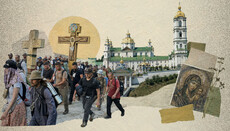
The enemy is the religious procession she planned to join to pray for her grandson in the trenches. That is now a “threat to national security.”
The enemy is her prayer in Church Slavonic, the same prayer she heard from her mother. That is now the “language of the enemy.”
Even the saints to whom generations of Ukrainians prayed are declared enemies.
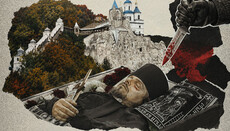
Then the parish is re-registered, the lock is cut off with an angle grinder, and the church is seized. And the old woman who comes to pray outside its locked gates officially becomes an enemy of Ukraine.
Now ask yourself: what exactly did this old woman and her Church do?
Here is what they did. While officials were stealing money meant for body armor, UOC parishes were buying body armor – with money donated by those same old women in headscarves. While defense budgets were being carved up in government offices, eparchies were buying vehicles and sending them to the front. While officials were stealing money meant for shelters, monasteries were delivering medicine, generators, and food to frontline cities. The Church has spent – and continues to spend – money on the wounded, on refugees, on people the state has no use for.
And church people do not consider any of this particularly heroic. They simply do it every day – without stepping up to microphones or demanding pensions worth hundreds of thousands of hryvnias.
This is the Church the state calls an “enemy.”
Former SBU chief Vasyl Maliuk boasted about the fight against “agents in cassocks.” According to him, during the war the SBU opened 174 criminal cases against UOC clergy, served 122 notices of suspicion, and secured 31 convictions. These figures are then cited as an argument for banning the Church.
Except nobody seems interested in doing the simplest arithmetic.
The UOC has more than twelve thousand clergy and thousands of monastics. One hundred seventy-four criminal cases amount to roughly 1.4 percent. Thirty-one convictions amount to 0.26 percent. Can an organization really be branded “enemy” when only about two people in every thousand have been convicted? In any other profession – including the SBU itself – that would be hailed as an extraordinarily clean record.
Now try to find a Ukrainian government agency where fewer than one person in a hundred is facing criminal charges.
You won’t.
Corruption has even been uncovered in the prosecutor’s office. The very institution that for four years has churned out indictments against priests, Orthodox journalists, and ordinary believers – on charges of treason, incitement, and aiding the enemy.
The people demanding years behind bars for clergy over sermons worked in the same building where, according to investigators, officials protected fraudulent call centers and kept safes stuffed with bundles of dollars.
There is no mystery here.
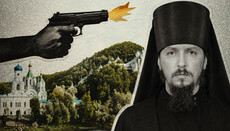
The UOC was designated as the enemy precisely to distract people while they are being robbed. The Church is not the enemy here. The Church is a lightning rod.
We can speak Russian. You can’t
Every day, earnest voices on television lecture us about how important it is to be patriotic, to love everything Ukrainian, to speak Ukrainian, and to preserve Ukrainian traditions. Then the security services release recordings of these same people talking among themselves – and it turns out they speak Russian.
The conversations in Mindich’s apartment – in Russian. Mudra’s conversations – in Russian. The people who came to court to vouch for her – speaking Russian. The colonel and the head of the regional SBU directorate dividing up money from the shelter scheme – speaking Russian. The figures in Operation Carthage – speaking Russian. SBU and military intelligence officers heading out armed for 1990s-style “showdowns” – all speaking Russian. Almost the entire ruling class – at home, in the kitchen, in the car, on the phone, in messaging apps, in the corridors of parliament – speaks Russian.
Ukrainian is for the podium, the television cameras, and the language laws.
Russian is for life, real business, and real money.
And the most cynical part is that this very same government fines a sales clerk for answering a customer in Russian or declares Church Slavonic – the language in which Kyiv has prayed for a thousand years – a “weapon of the Kremlin.”
So this is how it works: an ordinary person must prove his patriotism with every word he speaks and everything he does, while those at the top have nothing to prove.
The language ombudsman will not be knocking on their doors.
We don’t send our own children to war
So what is this entire apparatus for – the podium, the enemy in the headscarf, the language fines?
It exists so that the people looting the country can send other people to die for it.
Military recruiters grab mechanics, teachers, and tractor drivers. They grab them everywhere: on the streets, at workplaces, in fields, outside apartment buildings, and near stores. They haul them away in buses and send them to the front two weeks after receiving their draft notice.
Now go into the trenches and try to find the son of the judge drawing a 390,000-hryvnia pension. Or the son of the prosecutor who bought apartments in Bukovel. Or the son of a member of parliament. They are not there. They are studying in London and Vienna, vacationing on the French Riviera, and posting Instagram photos with ocean views. War is for the “rabble.”
And to make sure none of that “rabble” starts asking inconvenient questions, there is a ready-made answer waiting for them.
It is called “treason.”
Say the government is drowning in corruption – you will be accused of working for the enemy. Write that a church was seized with the help of the local authorities and police – you are Moscow’s accomplice. Ask why the shelters were never built – you are undermining the country’s defenses.
Today, people in Ukraine are being held in custody for precisely this: not for possessing weapons, not for passing missile coordinates, but for writing about officials stealing money meant for body armor and government employees breaking down church doors.
The people being jailed are not the criminals, but those who say stealing is wrong.
But the real question is not for the government. There have been no questions for it for a long time. Everything about it is already clear.
The real question is for those who still believe it.
For the person who is convinced that a UOC parishioner is his enemy, yet somehow fails to see the millions stolen in the highest offices of government. For the person who believes in “agents in cassocks” but forgets that his son died because his body armor was defective. For the person who comes to break down the doors of a church and then frantically searches for somewhere to hide from a ballistic missile because the government never built a shelter nearby.
Those are the people who need to be asked questions.
Because unless they are, they will never understand: what is called patriotism in Ukraine today has nothing to do with love of country.
And those who demand that others die for a country they themselves are selling off piece by piece are not patriots.
There is another word for them.
And everyone has known it for a very long time.