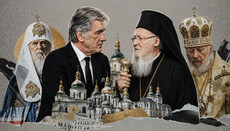
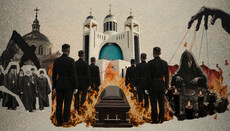
Can a monk be killed for giving the "wrong" response to "Glory to Ukraine"?
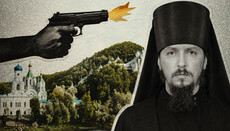
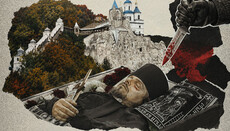
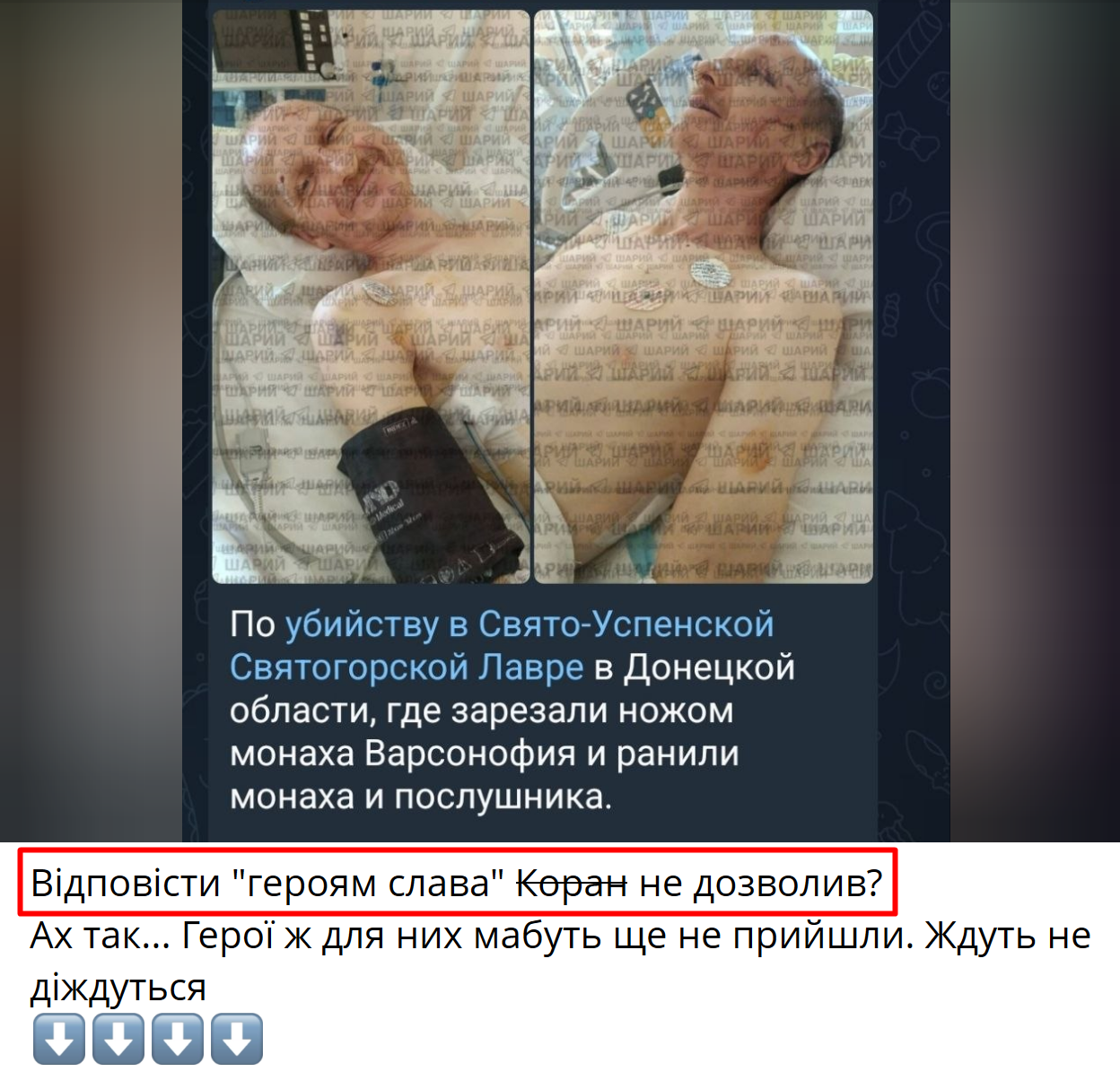
On August 23, 2026, a group of unidentified individuals attacked members of the monastic community on the grounds of the Sviatohirsk Lavra. Monk Varsonofiy (Turiansky) was killed. A monk named Gregory, who suffered a penetrating knife wound to the lung, nevertheless managed to make his way down to the monastic brothers’ quarters and call for help. Andriy Kyriienko, who lived at the monastery, was taken to hospital in serious condition.
Criminal proceedings have been opened in connection with the incident. The investigation is still ongoing, and the perpetrators have not yet been officially identified.
More details emerged two days later, when Andriy was able to speak. According to him, he was sitting alone on the upper grounds near the church when three men in full combat gear approached him. They were not the regular servicemen stationed above but, as he understood it, members of some kind of special unit. One of them said: “Glory to Ukraine.”
Andriy remained silent.
They demanded an answer again. He then replied as many Orthodox Christians would: “Glory to our Lord God. Save and preserve.”
That was when they began beating him. First with a wooden beam torn from a railing. When he tried to grab hold of it, they pulled out a knife.
For about 40 minutes, he lay in a ravine, drifting in and out of consciousness, hearing gunshots somewhere above.
The brethren found Monk Varsonofiy lying in a pool of blood on the landing of the Sts. Cyril and Methodius staircase. According to the Lavra, his final words were: “Glory to the Lord Jesus Christ!.. I am a monk.”
Who did this is for the investigation to establish. But there is another dimension to what happened – one that does not depend on the outcome of the investigation and must be discussed now.
A living human being was confronted with a choice: glorify the nation or glorify God.
He chose the latter. And he paid for it.
"What stopped them from giving the right response?"
As soon as the first reports of the tragedy at Sviatohirsk Lavra appeared online, a question began circulating – monstrous in its implications, yet one that deserves a serious answer:
What exactly stopped the monks from answering “the way they were supposed to”?
He could simply have said, “Glory to the heroes,” and walked away unharmed.
And Christians have heard that same question before – only phrased differently.

In the Roman Empire, followers of Christ were not necessarily required to renounce their God, blaspheme Him, or sign some declaration rejecting their faith. They were simply asked to throw a pinch of incense onto an altar before an image of the emperor.
It was an ordinary civic gesture performed by everyone in the Roman Empire, usually without attaching any sacred meaning to it. In modern language, we might call it an expression of patriotism toward the state.
Christians refused.
And Roman officials genuinely could not understand their stubbornness. Why would anyone rather die than do something every “normal” person did without hesitation?
Those who ask today what prevented the monks from giving the “correct” response to “Glory to Ukraine” are, in essence, asking the same Roman question.
The early Christians were not enemies of the state. But they refused to give the emperor the honor that belongs to God alone. In doing so, they followed Christ’s words literally: “Thou shalt worship the Lord thy God, and him only shalt thou serve” (Matt. 4:10).
The same principle is at stake today.
The monks of Sviatohirsk Lavra support their country. But they are not prepared to give it the glory that belongs to God alone.
Andriy Sheptytsky's criterion
The question of where love for one’s people ends and something very different begins is hardly new to the Church. Perhaps its clearest formulation came from a man whom no one could plausibly accuse of indifference toward either Ukraine or patriotism.
In 1941, Greek Catholic Metropolitan Andriy Sheptytsky wrote about whom a Christian should glorify:
“Replacing the age-old praise of Jesus Christ – ‘Glory to Jesus Christ!’ – with the words ‘Glory to Ukraine’ is a manifestation of godlessness. Obviously, no Ukrainian can object to the exclamation ‘Glory to Ukraine!’ But replacing the religious glorification of Christ with these words reveals a clear tendency to remove Christ and put the homeland in His place, and is therefore a sign of an openly godless tendency that deceives naïve Ukrainian patriots.”
Sheptytsky also stated that “Ukraine cannot exist at all as an independent state, much less become a glorious power, without the will of the King of kings and Lord of lords, the Eternal God Jesus Christ.”
And this raises a question.
Suppose, in some fantastic scenario, that the attackers at Sviatohirsk had encountered not the supposed “Moscow priests,” but the fiercely patriotic Metropolitan Andriy Sheptytsky.
How would that encounter have ended for him?
The same way it ended for Monk Varsonofiy?
Christ wrapped in an embroidered towel – with a flag in His hand
There is one detail in this whole story that would be impossible to make up.
The day after the attack, on August 24, cleric Ivan Rybaruk of the Orthodox Church of Ukraine, rector of the Church of the Nativity of the Theotokos in the village of Kryvorivnia, recorded a video address in which he described the presence of the Ukrainian Orthodox Church in Ukraine as “the presence of the enemy” and explained that this enemy should be fought. He accused the Ukrainian Orthodox Church of promoting the “Russian world” as a form of the heresy of ethnophyletism – the elevation of the nation above faith in God.
Let us not examine how far the Ukrainian Orthodox Church is actually removed from the “Russian world.” That is not even the point.
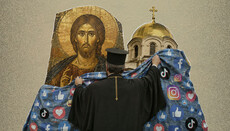
In the video, as Rybaruk speaks about ethnophyletism inside his church, a figurine of Christ can clearly be seen wrapped in a traditional Ukrainian rushnyk – with a Ukrainian flag placed in the Savior’s hand.
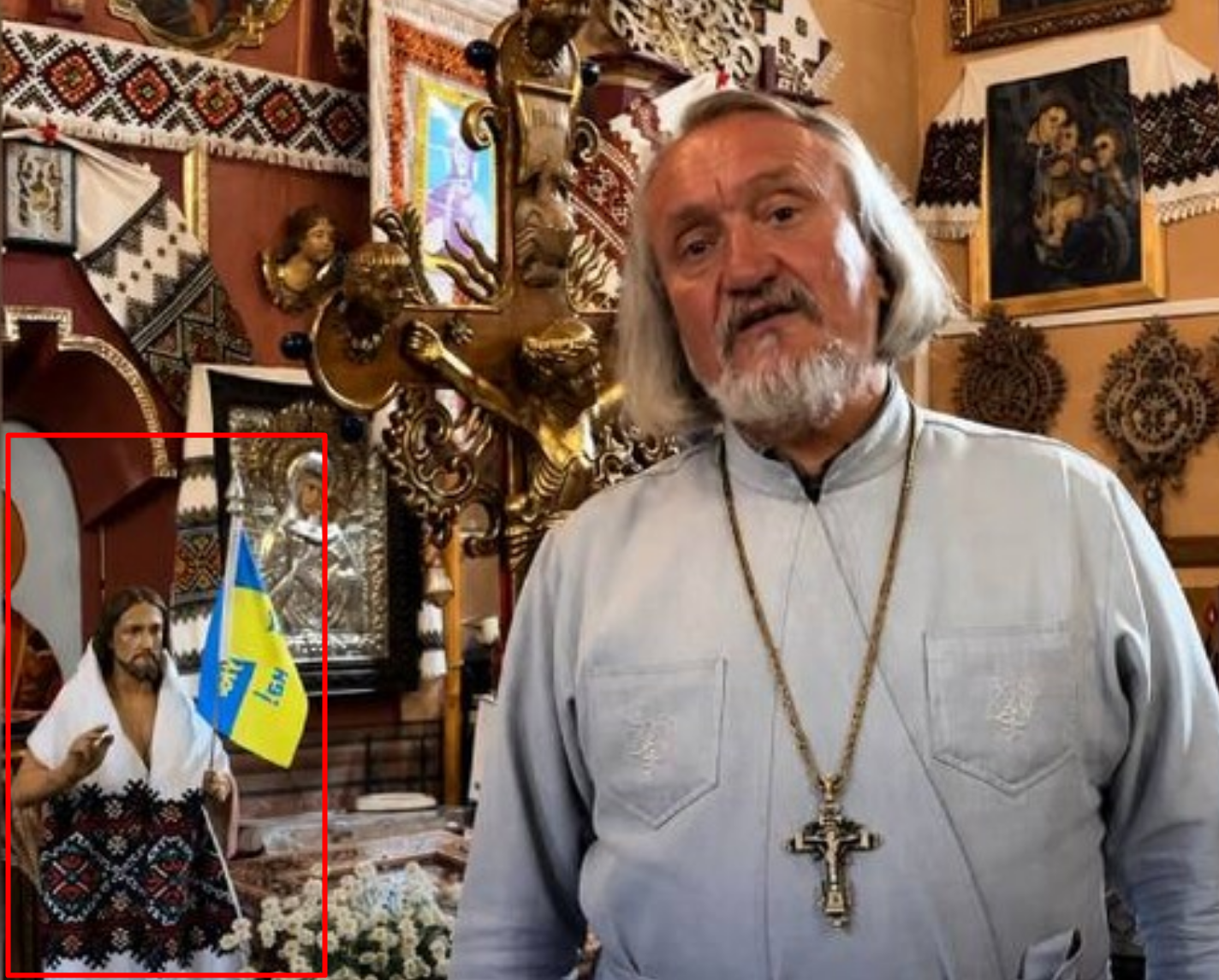
In other words, a man is condemning the subordination of the Church to the nation while having literally placed a national flag into the hand of Christ.
And he sees no contradiction whatsoever.
Because within the system of coordinates inhabited by this OCU cleric, ethnophyletism exists only when other people place their nation above the Church. When his own side does precisely the same thing, there is always some convenient explanation.
As usual, heresy is something found exclusively next door.
A question for every one of us
For years, we were told there was no contradiction. That one could calmly glorify God and glorify the nation, that one did not interfere with the other, and that there was no choice to be made because there was no conflict in the first place.
Now we know that this is not true.
A Christian can be confronted with a choice: God – or the nation. The earthly – or the heavenly.
And the serviceman who, at Sviatohirsk, demanded the “correct” response to “Glory to Ukraine” did not create that choice. He merely gave it a voice. The choice had been forming long before he appeared.
Christ said: “He that loveth father or mother more than me is not worthy of me” (Matt. 10:37).
Notice what Christ is speaking about here: one of the strongest, most natural, and entirely legitimate human affections. Love for one’s parents is not an idol, not a passion, not a sin. It is a direct commandment of God.
And yet even that love cannot stand above Him.
How much less, then, can a state, a political party, an army, or a slogan spoken aloud be placed above God?
The brethren of Sviatohirsk Lavra did not go looking for this choice. The monks almost certainly never imagined that such a choice would ever fall to them.
But the choice came looking for them.
At eleven in the morning.
Outside the walls of a church.
Without warning.
And the question each of us should ask ourselves now – not someday, not later, not when there is finally no time left to think – is this:
What will I say when my turn comes?
Because judging by the direction things are moving, we may not have long to wait before that question is put to us.
Perhaps far less time than we think.