Dechurching Ukraine: When everything is allowed and nothing is required
In any religious organization, there will always be clergy who behave disgracefully. In itself, that proves nothing. What does prove something is the reaction – or lack of reaction – to such behavior. More precisely, the absence of any reaction at all. That is why this article is not about the actions of isolated individuals, but about the fact that no one seems to regard those actions as a problem: not the people responsible, not their audience, and not the Church leadership.
The purpose of this article is not simply to catalogue ugly episodes involving OCU clergy. It is to answer a broader question: what is actually happening to religious consciousness in Ukraine? And what does the OCU have to do with it? Quite a lot.
We are watching a church structure that has effectively merged with the state steadily lose its ability to keep people rooted in the faith, leading society toward dechurching and, ultimately, paganism. That is the argument we will attempt to demonstrate.
First, one important clarification. Every episode described below comes from video material posted publicly by the people involved themselves. None was obtained through hidden-camera footage, ripped out of context by hostile critics, or reconstructed from eyewitness accounts. They filmed it themselves, edited it themselves, and posted it themselves – expecting their audience to approve. Some of the other examples come from television interviews and on-air comments – again, public statements prepared in advance.
That distinction matters: this is not compromising material. It is self-presentation.
Don’t want to fast? Then don’t
Well-known OCU “priest”-blogger Oleksiy Filiuk, who has amassed an audience in the millions, tells viewers that there is no need to fast. By his logic, fasting is something for people who have time on their hands and do not work.
“Look at all these fasters suddenly appearing... Eat boiled sausage. Just don’t eat each other’s livers. We’re working,” he tells his viewers during the Dormition Fast.
And this was no slip of the tongue. It is a consistent position. During Great Lent, Filiuk likewise urged people to eat sausage rather than indulge in “fanaticism.”
.jpg)
What is more, the OCU cleric does not merely tell people not to observe the fast – he discredits fasting itself. According to him, fasting was invented by Russians: “Eat. Cook yourself dairy food. There’s no sin in it. They came up with all these diets – it’s all from the Mokshans,” he says, using a derogatory term for Russians.
The claim that fasting originated in Russia collapses under the slightest scrutiny. The Forty-Day Fast, as well as weekly fast days, are documented in historical sources long before either the Moscow Patriarchate or Moscow itself existed. The Didache, a Christian text dating to the turn of the first and second centuries, already prescribes fasting on Wednesdays and Fridays.
It is hard to believe Filiuk does not know this. But to his multimillion-strong audience, he says something else – precisely what they want to hear.
Fasting, after all, is a small act of spiritual struggle. A strict fast – Great Lent or the Dormition Fast – can be a very tangible one. Many people find it difficult. And then along comes a pastor who gives permission: “Don’t be fanatical. Don’t want to fast? Then don’t.”
Everyone wins. The viewers get a “kind, modern priest.” Filiuk gets new admirers.
Want sex before marriage? No problem
OCU clergy offer Ukrainians the same principle when it comes to relations between men and women.
In August 2026, OCU “priest” Ruslan Usmedynskyi appeared on stand-up comedian Dmytro Tiutiun’s show “Not a Serious Conversation” and declared that sex before marriage is not a sin.
Asked directly by the comedian, “Why is sex before marriage a sin?”, Usmedynskyi replied that it was not: the OCU, he said, does not prohibit anything but can merely make recommendations.
“It’s not a sin,” he said, prompting delight from Tiutiun and the audience, who clearly had not expected such an answer. “Our Orthodox Church never forbids people anything at all.”
In a previous episode of the same program, the OCU cleric said that using a cassock as a prop in sexual role-playing can strengthen a couple’s relationship: “If you love him, buy him a cassock and fantasize – all the more so because it strengthens your family.”
In another segment of the interview, he described how, when he sprinkles people with holy water, some women get water in their mouths and spit it out. To such women, Usmedynskyi says: “Don’t spit it out!”
The “priest’s” final remark sent the host into fits of laughter – he clearly heard a very specific innuendo.
As with Filiuk’s “abolition” of fasting, what we have here is the image of the “good priest” who forbids people nothing and even indulges in vulgar jokes – and is therefore perceived by his audience as “one of us.”
The same category includes a video by OCU cleric Artem Fakhrutdinov, who said that a young man choosing a monastery should go exclusively to a women’s convent.
“A guy wants to enter a monastery and doesn’t know which one? Only a women’s monastery. Only a women’s one – don’t even think about it. What is there to do in a men’s monastery? Only a women’s one. Oh, that’s where all the beauty of God’s creation is,” the “priest” says.
Crude jokes about nuns and women’s monasteries have long been a staple of secular comedy. But how can a man who calls himself a priest speak like this?
And again, Fakhrutdinov’s words, like Usmedynskyi’s, were not an unfortunate joke that accidentally slipped out. This was a video that was recorded, edited, and prepared for publication. At every stage, there was an opportunity to abandon this kind of “creative” material.
Yet the OCU clerics apparently decided that it was perfectly appropriate coming from a man in a cassock.
People like it – so why not?
Want to seize a church from an “enemy of the people”? Follow an OCU pastor’s example
“Priest” Serhiy Yanchuk personally cut the locks off the UOC Church of St. Paraskeva in the village of Cherniavka, Zhytomyr Region.
Usually, OCU clergy leave the “dirty work” of church seizures to others – and often try to prevent anyone from filming it by blocking cameras or knocking phones out of people’s hands.
This case was different. Yanchuk happily posed for the photographer of a local newspaper. Here he is drilling through a lock. Here he is cutting it with an angle grinder. Here he is smashing it with a hammer.
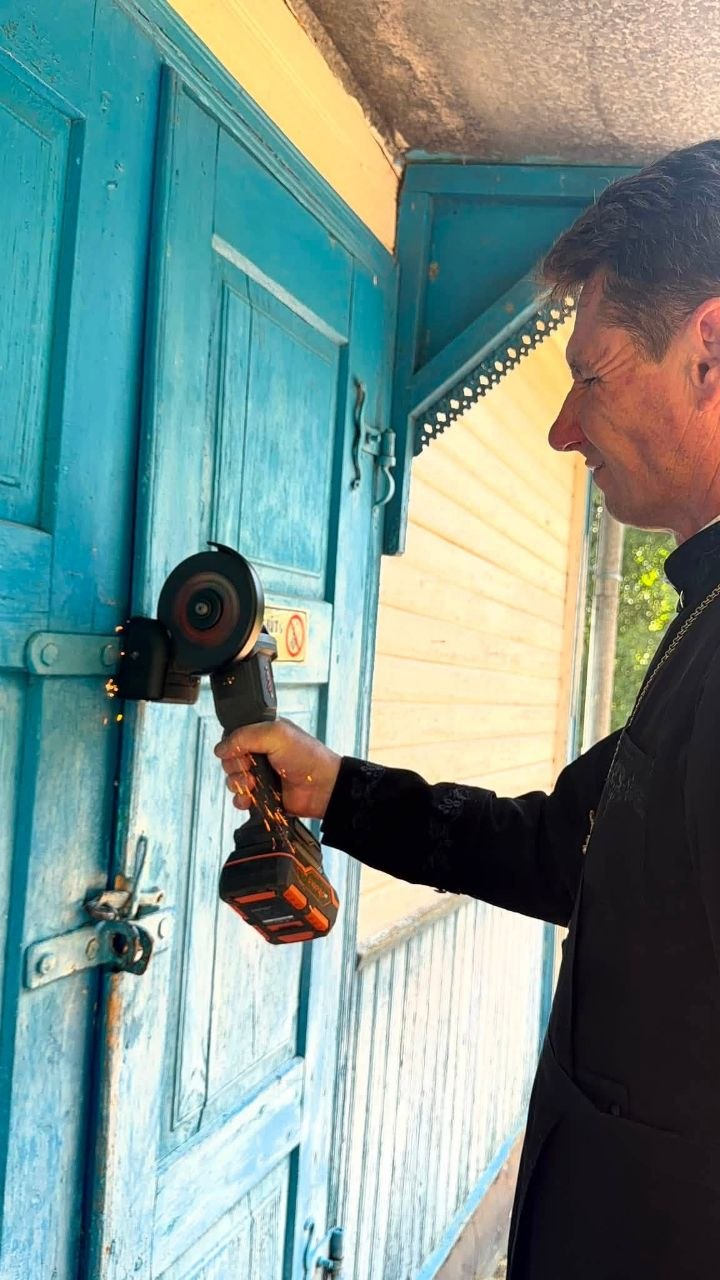
Let us stress the key point once again: this is not a parishioner, an activist, or an outsider. This is a man “in holy orders.”
Why does he allow himself to act this way? Because he regards the UOC rector who served in this church for many years as an “enemy of the people” – someone whose hand he would not even shake.
What are OCU parishioners supposed to do when they watch their pastor behave like this?
Naturally, they copy him.
Murder as a joke
In June 2025, after an attempt to seize the UOC Holy Spirit Cathedral in Chernivtsi failed, OCU “priest” Roman Hryshchuk effectively called for the killing of the believers who had defended their shrine.
He posted a clip from the film World War Z showing an army mowing down a crowd of zombies with machine guns, and wrote:
“In brief, this is what happened yesterday in Chernivtsi near the Holy Spirit Cathedral. We are still treating this Moscow Patriarchate sect with tolerance. It should be like this video.”
Hryshchuk also replaced the film’s original soundtrack with a speech in which Metropolitan Meletiy thanked the parishioners who had defended the cathedral. In other words, there could be no doubt about exactly whom he was suggesting should be killed.
Some time later, OCU propagandist E. Akopov from Kharkiv published a staged sketch in which he supposedly stuffs the body of a UOC priest who had refused to serve in Ukrainian into the trunk of a car.
The author presumably considers it a joke. But given what is happening to UOC clergy, the joke is more than a little strained.
The same applies to another example.
On Threads, military medic Uliana Kashchii recounted a conversation with her father about a UOC priest wounded in the war.
“Dad, imagine this – I got a wounded man brought in, a Moscow Patriarchate priest. He says theirs is the only true faith,” Kashchii wrote.
According to her, her father advised her to “finish him off.”
In the comments, the medic said it was merely humor: the priest remained alive and received the necessary medical care.
Nevertheless, as with Akopov, one cannot help recalling that every joke contains only a share of joking – the rest is truth. The harassment of the UOC by the authorities and society has brought us to a point where the idea of killing its clergy is treated calmly and even approvingly.
The murder at the Sviatohirsk Lavra
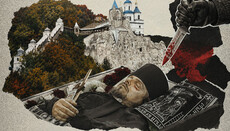
On August 23, 2026, unidentified attackers killed Monk Varsonofiy and wounded two other men.
According to novice Andriy, who suffered stab wounds, three men in uniform demanded the “correct” response to the greeting “Glory to Ukraine!” before the attack. When they heard the reply, “Glory to our Lord God. Save and preserve,” they attacked.
The investigation has not been completed, and we will not prejudge its conclusions.
But the environment in which such a crime became possible is plain to see. Roman Hryshchuk’s call for killing, Akopov’s “comedic” murder, Kashchii’s “joke” about “finishing off” a wounded UOC priest – all of this helped create, over the years, an atmosphere in which the murder of a monk ceased to seem unthinkable.
These are the consequences of a policy of inciting hatred against UOC believers and clergy – a policy in which OCU leaders and clerics have played a highly active role.
There is also a feedback loop at work: the more actively OCU representatives participate in incitement, the stronger the demand among part of society for criticism and even reprisals against “Moscow priests.” And the louder that demand becomes, the more readily it is serviced from the pulpit.
What do all these cases have in common?
If we sum up the episodes involving the public activities of OCU clergy described above, several things stand out.
- They are brazenly public. OCU clergy do not hide what they are doing – and judging by the lack of consequences, they have little reason to. In none of the cases above was there any canonical penalty, public distancing by Church leadership, or even a routine statement that “this is a private opinion.” The silence of the OCU leadership is not neutrality here – it is a form of consent. All the more so because almost everyone featured in this article has repeatedly received awards personally from Dumenko rather than reprimands.
- The direction is consistently toward stripping away the sacred. Fasting is unnecessary. Monasticism is ridiculous. Chastity before marriage is excessive. A UOC priest is an acceptable target for violence. Not one of these examples moves in the opposite direction.
- The overriding impulse is to please the audience and give it what it wants. Reduce all of the examples above to a single formula, and this is what remains: food, sexual instinct, and the appetite for violence. Wherever the Church calls its children to restraint and self-limitation, the OCU offers complete “freedom” to indulge desire.
Fasting is hard? Don’t be fanatical – eat some sausage and meat.
Hormones raging? Don’t restrain yourself – sex before marriage is not a sin.
Want to enter a monastery? Pick a women’s convent – that’s where the “beauty of creation” is.
Don’t like “Moscow priests”? They are enemies of the people and deserve to die.
But what happens to the spiritual life of those who listen to pastors like these?
Imagine a teacher who tells students not to waste time on textbooks but to relax on social media instead. A doctor who prescribes alcohol and fatty food instead of a strict diet. A coach whose only advice is to lie on the couch and eat cake.
All three would be loved.
None would help.
Today, the OCU is a structure religious in form but secular in substance. Its pastors do not lead people to Christ. Instead, they adapt themselves to the demands of secular society – in pursuit of an approving nod from an official or a like on social media.
Nothing more is required to dismantle a people’s religious consciousness. All that is needed is to keep reshaping the faith into whatever people happen to want from it.
We can see the results of this process in many examples in the West, where churches actively support LGBT causes, turn churches into restaurants or gyms, or even hand them over for use as mosques. Membership in such denominations is rapidly declining. People are, quite literally, voting with their feet.
Today, the state needs a “proper church” – a structure that supports those in power. Tomorrow, that need may disappear. And then it may turn out that such a church has nothing left with which to hold on to people.
A religion that demands nothing is of no use to society either. It is indistinguishable from a social club – and there is no shortage of social clubs without it.
What people will seek instead is a real Church – one that asks something of them. A Church that leads them along the real road: through fasting, self-restraint, and spiritual growth.
The same road along which it led generations of their ancestors.