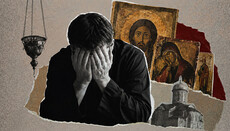
What to do if loved ones are destroying your soul?

Do you ever feel weighed down by the thought that your own family is slowly burning out everything alive inside you? We open the Bible, read the stern words from the book of Exodus about the necessity of honoring father and mother, and immediately catch ourselves feeling guilty. It seems to us as though Christianity demands that we endure any humiliation and constant emotional blackmail without question. Is that not what the fifth commandment says? Does the Apostle Paul not write plainly in his Epistle to the Colossians: «Children, obey your parents in all things» (Col. 3:20)?
But when we open the apostle's epistle to the Ephesians, we stumble upon a tiny, almost imperceptible addition: «Children, obey your parents in the Lord» (Eph. 6:1). This small insertion «in the Lord» is precisely what excludes the principle of blind submission to the will of relatives.
Saint John Chrysostom, commenting on this passage, offers a remarkably sober explanation. If a parent pushes a child toward wickedness, compels them to shameful acts, or literally drains the soul out of them, such a command goes against the will of the Creator. It cannot be obeyed. Blessed Theophylact of Bulgaria takes this rule from the Epistle to the Ephesians and boldly applies it to the words «in all things» from the Epistle to the Colossians. Obedience «in all things,» in his view, does not mean consent to sin.
The Apostle Peter and the other disciples of Christ expressed this principle before the court of the high priests: we ought to obey God rather than men. This apostolic ultimatum becomes the chief measure of our relationship with the world. If we are required to betray the truth, trample our conscience, or turn our life into servitude to another's tyranny, we have every right to say a firm «no» to the abuser.
When the sanctuary becomes a sword
In the Gospel of Matthew there are words of the Savior that may send a chill through the reader's heart: «Do not think that I came to bring peace on earth — I did not come to bring peace but a sword, for I came to set a man against his father, and a daughter against her mother... And a man's enemies will be those of his own household» (Matt. 10:34-35).
Why does the Creator speak of a sword and division? Saint John Chrysostom explains that the sword here is the word of faith. It severs a person from familiar family ties when those ties hinder his spiritual growth. Christ longed for unity among people, but when loved ones choose sin or stubborn resistance, division becomes inevitable. Blessed Augustine calls this sword the sword of the Spirit, and Blessed Jerome of Stridon notes that after the preaching of the Gospel even the strongest household inevitably divides into believers and unbelievers. False peace is destroyed for the sake of true salvation.
And in the Gospel of Luke, Christ speaks an even sterner word: «If anyone comes to Me and does not hate his father and mother... he cannot be My disciple» (Luke 14:29). We are frightened by the terrible word «hate.» But the ancient Hebrew idiom, to which biblical scholars point, reveals here no call to malice whatsoever.
To hate in this context means only to establish an order of preferences. Love for Christ must be so deep and all-encompassing that every other attachment appears secondary by comparison.
What matters most to us is the chief pastoral conclusion from everything we have read: if the choice stands between pleasing God and the opinion of our relatives, we have no right to betray God for the sake of another's approval.
The principle of Corban
But here it is important not to fall into the opposite extreme. Sometimes we begin to use our status as «deeply devout people» as a convenient shield to refuse care for elderly or sick parents. We want to think: «Since they do not go to church, criticize my faith, and irritate me, I will simply write them out of my life for the sake of my own peace.»
The Gospel instantly exposes this Pharisaic trick. In the Gospel of Mark, the Savior sternly rebukes the scribes who invented clever rules for self-justification. A man could say to his father or mother: «Corban, that is, a gift to God, whatever you might have received from me» (Mark 7:11). And under this pious pretext the Pharisees permitted a man to do nothing more for his destitute parents. Christ calls this making the word of God of no effect through human tradition.
The boundary of obedience to loved ones does not lie where we have become uncomfortable or offended. The boundary lies where we are required to commit sin.
Look at the Savior. When His brothers and His Mother stood outside the house and called for Him, He looked around at those sitting nearby and said: «Here are My mother and My brothers; for whoever does the will of God is My brother and My sister and mother» (Matt. 12:48). He established the unconditional priority of spiritual kinship over blood kinship. But that same Christ, while dying, took care of His Mother's earthly future. He saw the beloved disciple and said: «Woman, behold your son» (John 19:26). And from that hour the disciple took Her into his own home. John did not flee from responsibility, did not hide behind his Divine calling, but cared for the Mother of God until the very end of Her life.
Imprisonment in a tower and the choice of mercy
Church history knows terrible examples of a loved one becoming an executioner. The holy great martyr Barbara was the only daughter of a wealthy and noble pagan named Dioscorus. Wishing to hide the maiden from outside eyes and to control her life completely, her father locked her in a tall tower. But when the saint came to believe in Christ and received baptism, mere control was no longer enough for her parent.
Upon learning of his daughter's faith, Dioscorus fell into a furious rage. The saint attempted to hide in a mountain cleft, but her father found her, beat her, and personally brought her before the city's ruler for judgment. He publicly renounced his own child. Moreover — when the ruler sentenced the girl to death, it was her father who demanded to carry out the sentence personally. Thus the holy maiden's own father became her executioner.
This hagiographic account shows us the most extreme point to which human blindness can reach. The words of Scripture «a man's enemies will be those of his own household» were fulfilled here with terrifying precision. To this day, the great martyr Barbara gives us a spiritual point of support when we suffer from the cruelty of our own relatives.
Of course, we are far from the feat of Saint Barbara. But when loved ones try to figuratively lock us in a tower, demanding we renounce our faith, breaking our psyche, or feeding on our inner pain, we have every right to distance ourselves from them.
To love a destructive parent does not mean becoming a silent accomplice in their evil. Likewise, avoiding contact with someone who is breaking our soul does not mean betrayal. Love can be distant, restrained, expressed in prayer, a brief phone call, and the delivery of medicine or food through a third party. We are not obliged to surrender our soul to be torn apart simply because blood ties bind us to someone. To honor one's parents means to desire their salvation, to pray for them, to help them in difficult situations — while at the same time preserving one's heart for God, Who grants us true freedom.