The mysteries of Golgotha in the light of archaeology
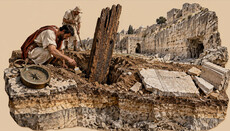
The veil of centuries obscures what really happened in the fourth century. Archaeology and ancient texts shed light on the true history of one of Christianity’s greatest sacred sites.
According to established Church tradition, around 326, St. Helen, Equal-to-the-Apostles and mother of Emperor Constantine, came to Jerusalem intending to find the sites of Christ’s Passion and the Life-Giving Cross. But none of Jerusalem’s inhabitants at the time knew the location of the Crucifixion. After an extensive search, Helen was directed to a Jew named Judas, who long refused to reveal the site but eventually disclosed it after being tortured.
At the empress’s order, a pagan sanctuary built by the Romans on Golgotha was dismantled. Excavations uncovered the place where Jesus had been buried and three crosses – Christ’s and those of the two thieves crucified with Him – along with the plaque bearing Pilate’s inscription and the nails. Since there was no way to determine which of the three crosses belonged to the Savior, Bishop Macarius of Jerusalem proposed that they be tested by a miracle. According to one version, the crosses were placed one by one against a gravely ill woman, who was healed when one of them touched her. According to another, the true Cross restored a dead man to life.
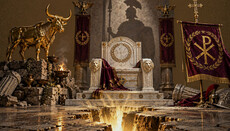
Judas, who had revealed the location of Golgotha, was baptized with the name Cyriacus and later even became a bishop. The wood that had been found was then recognized as the Cross of Christ. According to tradition, part of the relic remained in Jerusalem, while Helen sent another part to Constantine, and the nails that had been discovered were incorporated into the imperial regalia and the emperor’s horse bridle. Church tradition associates these events with the beginning of the universal veneration of the discovered Cross and, subsequently, the feast of its Exaltation.
It is a beautiful story, but unfortunately, no source contemporary with these events contains such an account.
Empress Helena's imperial mission
Our principal source of information about these events is Eusebius of Caesarea’s Life of Constantine. It is a rather complicated source. On the one hand, Eusebius was a contemporary of the events, lived in Palestine, was well acquainted with Constantine’s activities in the East, and described the events in Jerusalem in considerable detail. On the other hand, Eusebius can, in a certain sense, be regarded as Constantine’s court panegyrist, consistently seeking to emphasize the piety of the emperor and his family. His work can hardly be called impartial. Yet for precisely this reason, the absence of any account of the discovery of the Cross is particularly striking.
Eusebius describes in detail how, on Constantine’s orders, the pagan structure was dismantled, its stones and soil removed, and the site cleared. A rock-cut tomb was then revealed and identified as the place of Christ’s burial and Resurrection. Yet Eusebius says nothing about the Cross.
Eusebius also describes Helena’s journey in considerable detail, but he does not connect it with the excavations in Jerusalem, much less with the discovery of Christ’s Cross. According to him, the elderly empress traveled to the East to venerate the holy places, but her journey was not merely a pilgrimage. She visited cities, distributed money to the population and the troops, aided the poor, freed prisoners, and recalled exiles. All of this was entirely consistent with the Roman tradition of strengthening the authority of the imperial house in the provinces.
Modern historians generally view the journey as both a pilgrimage and an imperial mission, undertaken for a combination of religious, dynastic, and political reasons. One view holds that one of its principal purposes was to consolidate Constantine’s power in the East following his victory over Licinius.
Another theory links the journey to the family tragedy of 326, when Constantine’s son Crispus and his wife Fausta were put to death on his orders – although Constantine’s responsibility for his wife’s death is not considered conclusively established.
According to this interpretation, Helena’s journey to the East was a kind of penitential mission, but there are no direct sources confirming this theory.
Eusebius connects Helen’s journey with the construction of churches in Bethlehem and on the Mount of Olives. Yet neither Eusebius nor any other contemporary author says that Helen traveled to Palestine specifically to search for the Cross or the Holy Sepulchre, or even that she participated in the search. The sources say only that the presumed site of Christ’s burial was uncovered on Constantine’s orders. The discovery of the Cross is not mentioned at all.
Three hundred years of silence at Golgotha
Nearly three centuries passed between the Crucifixion of Christ and the excavations in Jerusalem. During those centuries, Jerusalem endured wars, destruction, and a radical transformation of its urban landscape.
In AD 70, during the First Jewish–Roman War, the Roman army under Titus captured Jerusalem. The Temple was completely destroyed, and Jerusalem itself was reduced to ruins. There are reports that the Temple Mount was plowed over. Josephus claims that 1.1 million people died during the siege, and although modern historians consider this figure exaggerated, the death toll was enormous. According to Eusebius, Jerusalem’s Christian community had moved to the town of Pella in Jordan before the war began.
Several decades later came the Bar Kokhba revolt, which Emperor Hadrian suppressed in 135. A Roman colony, Aelia Capitolina, was established on the site of Jerusalem. Jews were forbidden not only to enter Jerusalem but even to look at it from a distance. The city was extensively rebuilt according to a new plan, with Roman structures erected throughout it, including pagan sanctuaries. The Roman historian Cassius Dio, who lived in the late second and early third centuries, explicitly speaks of a new city being built on the site of the destroyed Jerusalem.
Around this same period, Christians returned to Jerusalem, but these were no longer Jewish Christians. They were converts from pagan backgrounds of various ethnicities. In 135, Mark became bishop of Aelia Capitolina – the first Gentile bishop of the community.
Could knowledge of the precise location of Christ’s Crucifixion and burial have been preserved within the Christian community under such circumstances for almost three centuries? We simply do not know. No reliable evidence survives that Golgotha and the Holy Sepulchre were places of veneration or pilgrimage in the second and third centuries. Yet neither can we say that the memory of Golgotha disappeared completely.
Around 314, even before Constantine’s work began in Jerusalem, Eusebius of Caesarea wrote in his geographical reference work on biblical sites, the Onomasticon: “Golgotha – the Place of the Skull, where Christ was crucified; it is still pointed out today in Jerusalem, north of Mount Zion.” In other words, by the beginning of the fourth century there was a local tradition associating a particular site in Aelia Capitolina with Christ’s Crucifixion. But whether that tradition had continued uninterrupted from apostolic times, and whether it referred to the exact location where the Church of the Resurrection would later stand, cannot be established.
Another question is what could have happened to the Cross itself during those 300 years after the Crucifixion.
Here, the popular Church account encounters another difficulty. A Roman cross was not necessarily a unique object made separately for each condemned person and then preserved with the body or somewhere nearby. Crucifixion practices varied across periods and regions. But a well-known form consisted of a vertical post (stipes) and a crossbeam (patibulum).
As a rule, the condemned man carried the crossbeam to the place of execution, while the vertical posts remained fixed in the ground. The crossbeam, too, was generally reused, particularly because timber was scarce in Judea and therefore relatively valuable. Crucifixions took place on a significant scale in Jerusalem during the first through third centuries. The Jewish historian Josephus writes that during the siege of AD 70, the Romans crucified as many as 500 people a day, sometimes more. According to him, the number of victims became so great that there was “not enough room for the crosses and not enough crosses for the bodies.”
The first evidence of the Jerusalem relic
Whatever happened, there is no doubt that roughly 20 years after the excavations at the site of today’s Church of the Resurrection, a relic venerated as the Cross of Christ existed in Jerusalem. Around 350, St. Cyril of Jerusalem repeatedly mentions the “holy Wood of the Cross” and says that fragments of it had spread throughout the world: “The whole world has been filled with pieces of the wood of the Cross.”
Yet Cyril says nothing about three crosses, a miraculous healing or resurrection of a dead man, or Judas-Cyriacus, who supposedly knew the location of the Crucifixion. More importantly, Cyril never connects the discovery of the Cross with Helen.
Several decades later, the pilgrim Egeria described the veneration of the Wood in detail on Good Friday. The bishop held the relic, deacons guarded it, and the faithful approached and kissed it. Egeria even tells of a pilgrim who once managed to bite off a piece of the wood, after which the relic was guarded with particular care. She does say that the Cross had been “found” and associates its discovery with the dedication of Constantine’s church complex of the Holy Sepulchre. Yet Egeria, too, gives no account of Helena and the three crosses familiar to us today.
The birth of the later hagiographic tradition
The first versions of the familiar legend appear around 395 – some 70 years after the events. Ambrose of Milan says that it was Helen who searched for the Cross, that she found it together with the nails, and that Christ’s Cross was identified by Pilate’s inscription. According to Ambrose, one of the nails was placed in the imperial diadem and another in Constantine’s horse bridle.
At roughly the same time, Sulpicius Severus gives an account involving three crosses and the miraculous resurrection of a dead person. Similar versions soon appear in Rufinus and later in Socrates Scholasticus and Sozomen.
In Socrates, the account is already very close to the later hagiographic version: Helena arrives in Jerusalem and orders excavations, during which three crosses and Pilate’s inscription are discovered. Bishop Macarius then places the crosses against a dying woman, and one of them heals her. Socrates himself, however, omits some details and notes that he heard the story from others, adding that it was widely known.
Finally, by the mid-fifth century, Sozomen introduces a version involving a Jew who learned the location of Golgotha from documents handed down in his family. Still later, this unnamed figure becomes Judas-Cyriacus, who somehow knew where the Cross was located but refused to reveal it. Pious Christians then subjected him to torture, after which he disclosed the location of Golgotha. Having witnessed the miracle of healing – or, in another version, resurrection – he was baptized and later became a bishop.
Thus, by approximately the fifth century, the legend of the discovery of the Cross had taken the form familiar to us today. Modern scholars assess it differently. Some believe that the later narrative may preserve a genuine historical core, while others are considerably more skeptical.
Some researchers allow that wood may indeed have been discovered during excavations at Golgotha and subsequently identified as the Cross of Christ. Others believe that nothing definite can be said about the origin of the relic whose veneration Cyril of Jerusalem attested around 350.
Archaeology beneath the church
The most cautious reconstruction of the fourth-century events looks something like this: under Constantine, the site of today’s Church of the Resurrection was indeed cleared. Beneath the Roman structures, workers discovered an ancient burial complex and a rock-cut tomb that local Christians identified as the Holy Sepulchre. Beyond these facts – and the fact that a venerated relic of the Cross existed in Jerusalem by 350 – nothing can be stated with certainty.
It should be noted that some scholars have proposed alternative locations for Golgotha and the Holy Sepulchre. There are indeed several sites near Jerusalem’s Old City that could fit the Gospel description. Nevertheless, the traditional location of Golgotha has stronger arguments in its favor. Modern excavations have further strengthened that case.
Research confirms that the site of the present-day church was originally a quarry. After stone extraction ceased, parts of the area were used for gardens and burials. By the time of Christ, the former quarry was already being used as a burial ground. It lay outside the city wall, consistent with the Gospel account of Jesus being executed and buried outside the city. Rock-cut tombs did indeed exist there.
Archaeologists have also examined the remains of Roman-period structures that once blocked access to the tomb later venerated as Christ’s. Parts of the foundations of a cultic complex dating to Hadrian’s reign were discovered, and this complex was dismantled during construction under Constantine. This corresponds with Eusebius of Caesarea’s account that a pagan structure stood over the site of the future Christian church and was demolished on Constantine’s orders.
In September 2026, archaeologists from Sapienza University of Rome presented another update on their years-long research beneath the floor of Jerusalem’s Church of the Holy Sepulchre. Analysis of the artifacts discovered there is still underway, but a fairly clear picture is already emerging.
The findings confirm that the site once contained an ancient quarry, that parts of it were later used for agriculture and burials, that it subsequently became part of Roman Aelia Capitolina, and that in the fourth century it was completely transformed under Constantine the Great.
Particularly intriguing was the discovery of traces of an ancient garden. Archaeologists found low stone walls marking plots of cultivated soil, while analysis of the soil and pollen revealed traces of grapevines and olive trees. Rock-cut burials were located nearby. The resulting landscape corresponds remarkably well with the words of the Gospel of John: “Now in the place where He was crucified there was a garden, and in the garden a new tomb” (John 19:41).
Modern archaeology, however, cannot establish who was buried in any particular tomb at the site, nor has it produced any evidence confirming that the Cross of Christ was discovered there.
The silence of the early Christian community
This raises one of the most intriguing questions in early Christian history. On the one hand, we have abundant evidence that by the second century Pascha was already firmly established as a Christian feast. Polycarp of Smyrna and Bishop Anicetus of Rome debated the date on which it should be celebrated. Melito of Sardis composed a special Paschal homily, and by the end of the second century the date of Pascha was being debated at councils, including one involving Bishop Narcissus of Jerusalem. Eusebius of Caesarea describes these controversies in detail in his Ecclesiastical History.
At the same time, Christians were already prayerfully commemorating specific places associated with martyrs. The Martyrdom of Polycarp relates that his remains were collected and placed in a particular location, where the anniversary of his martyrdom was celebrated each year. Around 200, the Roman Christian Gaius could point to the “trophies” of the Apostles Peter and Paul on the Ostian Way and at the site of the present-day Vatican.
Against this background, the absence of evidence for the veneration of Golgotha and the Holy Sepulchre is particularly striking. We know that the Church of Jerusalem existed, that it celebrated Pascha, and that interest in places associated with Christ’s earthly life gradually increased. Around 314, Eusebius even wrote in his Onomasticon that Golgotha was “still pointed out” in Aelia.
Yet there is no reliable evidence that Christians in the second and third centuries made pilgrimages there, prayed there, or celebrated Paschal services there – something one might reasonably expect. Modern scholars of early Christian holy places, including Joan Taylor, Robert Markus, Brouria Bitton-Ashkelony, and Daniel A. Smith, have also drawn attention to this paradox.
They differ in their explanations for this silence, but agree on one point: the picture familiar from later Christianity – of Golgotha and the Holy Sepulchre being continuously venerated from apostolic times onward – is not confirmed by the historical sources of the first three centuries.
In our next article, we will try to explain this paradox and answer two related questions: Why did Constantine decide in the early fourth century to clear the site associated with Golgotha and the Holy Sepulchre, and how did the tradition of venerating the Cross arise?