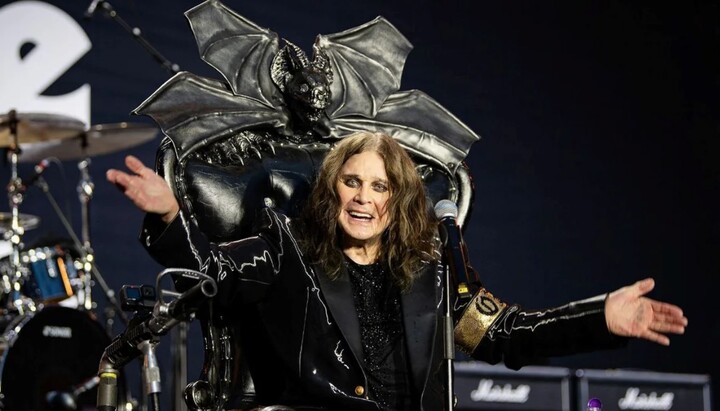
On July 22, 2025, the person known as the godfather of heavy metal passed away. He called himself the Prince of Darkness and surrounded himself with demonic symbolism. His life and death give food for thought. Heavy metal is not just a music genre; it’s an entire culture that has shaped millions of people worldwide. Metallica, AC/DC, Iron Maiden, Nirvana, and others are idols for teenagers and young adults, and often for older generations as well. Many believers, even priests, once got into heavy metal, and for many, giving it up was a symbol of moving from darkness into the Light. For some, this music still resonates today. But where does all this demonism in the music come from? So many occult, satanic symbols? Why the thirst to associate oneself with forces of evil, the constant depiction of skeletons, monsters, blood, and more? Where does all this hellish imagery come from — songs like “Hells Bells,” “Highway to Hell” by AC/DC, “Hell Awaits” by Slayer, and so on? Where does this raw, powerful, screaming music come from? Where does this emotional intensity come from? And why has this demonism become so attractive to millions? An interesting fact: almost all heavy metal stars say they are not ideological Satanists, and all this paraphernalia is nothing more than a stage image. That is, they are well aware that Satanism is bad, hell is scary. Even Ozzy Osbourne admitted in his autobiography I Am Ozzy that he is afraid of hell: "I've done so much bad that if hell exists, that's where I belong. But I hope God will forgive me." In other words, they all know where good and evil are, yet they surround themselves with pentagrams, inverted crosses, sing about death and hell, twitch on stage like possessed, and so on. Ozzy Osbourne even bit the heads off live pigeons and bats. True, it was only once, but nevertheless. The first explanation that comes to mind is simply disbelief in the real existence of hell, the devil, and so on. A frivolous attitude towards it. It's cool, and it sells well to the public, brings money. Why not use it? But if you think about it more seriously, you can see that all this demonic culture is a protest. A protest of people who did not see truth, love, God where they should have seen Him. A protest against the official Church, official Christian teaching, accepted morality. A protest against the monstrous gap between the Gospel and the lives of those who preach it, between Christ and the people who call themselves Christians. If a person sees that under the symbols of the Cross, icons, and the Gospel, people deceive, profit, oppress others, and so on, he/she has a desire to run away from it as far as possible. In the opposite direction. To that very demonic symbolism. And if people who call themselves followers of Christ do the exact opposite of what Christ commanded, if this lasts for centuries, turns not just into a culture but into a whole civilization, then as a protest against this deception, an opposite culture arises, glorifying Satan and surrounding itself with all this demonic entourage. European civilization is commonly considered Christian, but the tortures of the Catholic Inquisition, in terms of their scale, cruelty, and sophistication, far surpassed the tortures and persecutions of the pagans. To the greater glory of God (Ad majorem Dei gloriam), fires burned throughout Europe, burning those whom Christian pastors considered witches and heretics. Christian nations of Europe exterminated each other throughout almost their entire history. Remember in Dumas’s The Three Musketeers how one of the characters explained why Catholics were killing the Huguenots? It was because the Huguenots sang the Psalms in French, while the Catholics sang them in Latin. Of course, the reasons for the constant wars were more complex than that, but nonetheless, all this had nothing to do with the Gospel. And in these wars participated abbots, bishops, and even some Roman popes led troops into battles. Magnificent cathedrals were built at times when ordinary people were ravaged by famine and epidemics, yet money was spent on buildings, luxury, and entertainment – not on helping those in need, which the Savior explicitly commanded. And when these desperate people, driven to the brink of despair, rose up in rebellion, these uprisings were crushed with particular cruelty, resulting in tens of thousands of victims. And all this was done by those who on Sundays attended Mass and listened to the Gospel. And it was not only so in Europe. Archimandrite Spiridon (Kislyakov) in his Diary describes how in the early 20th century, being a missionary in Siberia, he preached Christianity in one of the Buddhist monasteries. The monks listened to him with attention and interest, and then one of them said: "The Christian religion is the highest, universal religion... not of the world, but God's revelation. But look yourself, Mr. Missionary, look impartially, does the world live as Christ taught?... You live among yourselves like some bloodthirsty beasts. You should be ashamed to even speak of Christ, your mouth is all in blood. Among us, there is no one worse in life than Christians. Who here cheats, fornicates, robs, lies, wars, kills the most? Christians, they are the first apostates.... The great Siberian road has begun to be built.... We eagerly awaited when the road would come to us. And we waited to our horror and grief. Your workers came to our yurts already drunk, got the Buryats drunk, corrupted our wives, among ourselves appeared drunkenness, robberies, murders, fights, quarrels, and diseases. We had no locks until then because there were no thieves, even more so, there was no murder.... No, Mr. Missionary, first let the Christians themselves believe in their God and show us how they love Him. Then maybe we will accept you, missionaries, as angels of God, and accept Christianity." Spiridon recounts how after this he wept and cried out to God, unable to bear the truth of these words. Unfortunately, such a description is the general background of the life of almost all Christian nations in all periods of history. Therefore, holy people who dared to follow the Gospel in their lives, rather than the accepted order of things, are so noticeable against this background. Almost all of them faced misunderstanding from civil and church authorities, and this is in the best case. For example, John of Kronstadt, from the very beginning of his pastoral ministry, began to put into practice what is written in the New Testament. He went to the slums, helped the poor, and comforted the grieving. This was so unusual for his fellow priests that they treated him with suspicion and even wrote complaints to the Synod and government authorities. Unfortunately, none of this is new. Jesus Christ was very merciful toward obvious sinners but relentlessly rebuked the Pharisees, who wore the mask of righteousness yet lived worse than pagans: “Woe to you, scribes and Pharisees, hypocrites! For you clean the outside of the cup and dish, but inside they are full of extortion and wickedness. Blind Pharisee! First clean the inside of the cup and dish, that the outside may also be clean. Woe to you, scribes and Pharisees, hypocrites! For you are like whitewashed tombs, which outwardly appear beautiful, but within are full of dead men’s bones and all uncleanness. So you also outwardly appear righteous to men, but within you are full of hypocrisy and lawlessness” (Matthew 23:25–28). The Apostle Paul, addressing the same category of people, said: “You, then, who teach others, do you not teach yourself? You who preach against stealing, do you steal? You who say that people should not commit adultery, do you commit adultery? You who abhor idols, do you rob temples? You who boast in the law, do you dishonor God by breaking the law? As it is written: 'God’s name is blasphemed among the Gentiles because of you’” (Romans 2:21–24). Ozzy Osbourne grew up in a religious family in conservative Birmingham, England, and even served as an altar boy in church as a child. But something made him turn away from this and call himself the Prince of Darkness. Every person in life seeks goodness and love. At first, they turn their gaze to where these should be found: to God, to the Church, to the disciples of Christ. But when they don’t find them there, they turn in the opposite direction. And in that direction, they won’t find what they’re looking for either—because it simply isn’t there. Very often, this leads to despair and destruction. Looking at all these demonic figures in heavy metal and their followers, one can’t help but think: “Thank God I’m not like them – I go to church, read the Gospel, follow my prayer rule. I’m on the right side.” But are we truly innocent when people turn to the dark side? Could it be that Jesus spoke about us when He said: “But whoever causes one of these little ones who believe in Me to stumble, it would be better for him to have a heavy millstone hung around his neck and to be drowned in the depth of the sea” (Matthew 18:6)? If we, calling ourselves Christians, do not live in a Christian way, do not show in ourselves the love for our neighbors that Christ spoke of, are we not causing these "little ones" to stumble? Do they leave this life unrepentant and unreconciled with Christ because those who claimed to follow Him showed only “a form of godliness but denied its power”? (2 Timothy 3:5) Ozzy Osbourne has died, but thousands of his followers continue to venerate, even if superficially and symbolically, the forces of darkness. But can we honestly say we bear no responsibility for that? "When I say to a wicked person, ‘You will surely die,’ and you do not warn them or speak out to dissuade them from their evil ways in order to save their life, that wicked person will die for their sin, and I will hold you accountable for their blood" (Ezekiel 3:18). We, as Christians, can warn a sinful world by showing love to others and living according to Christ’s commandments. But are we doing that?