Golgotha in the Midst of a Pogrom
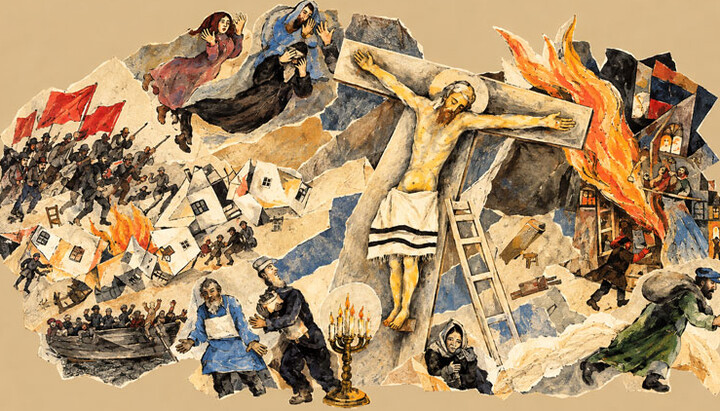
Fragments of the painting. Photo: SPZh
We are used to crucifixions in secular paintings being surrounded by gold and purple, mourning women and weeping angels. Here there is nothing of the kind. Before us is a canvas that is almost entirely white. A broad ray of cold light falls diagonally from above, and in its halo, on the cross, hangs Christ. Instead of the usual loincloth, He wears a tallit – the striped prayer shawl that Jews wear in the synagogue. Above His head is an inscription in Hebrew. And all around is fire.
The painting is called «White Crucifixion». Chagall painted it in Paris at the end of 1938, shortly after Kristallnacht, when synagogues burned across Germany and Jewish homes and shops were looted.
A painting carted around like a criminal
Chagall knew from his own experience what persecution was. In 1933, his painting «A Pinch of Snuff», also known as «The Rabbi», was taken from a museum in Mannheim and displayed at a Nazi exhibition titled «Images of Cultural Bolshevism». According to contemporaries, the canvas was paraded through the city in a cart, like a criminal being taken to execution, and hung in shop windows with humiliating captions. The painting was publicly humiliated as though it were a living person.
In 1937, Chagall's works were confiscated from German museums, and three of them were shown at the «Degenerate Art» exhibition. That same year, the artist finally received French citizenship, which had previously been denied him. He lived in Paris, but he understood that the calamity creeping across Europe would sooner or later reach him too.
When news of Kristallnacht arrived, Chagall picked up his brush. And he painted Golgotha.
Christ in a tallit
Let us look more closely at the canvas. The edge of the tallit covers Christ's head like a kerchief – where we are accustomed to seeing the crown of thorns. On the cross, instead of the Latin abbreviation INRI, is written in Hebrew: «Yeshua HaNotzri Melech HaYehudim» – «Jesus of Nazareth, King of the Jews».
Where mourners usually stand, Chagall placed scenes of a pogrom. A synagogue is burning, and sacred books have been thrown out of it into the street. City houses are ablaze, and soldiers with red flags advance. A boat overloaded with refugees drifts by. An old man trudges along with a sack on his back – the eternal wanderer, driven from place to place. A mother runs, clutching her child. And above the cross, in the sky, Jewish elders hover and mourn everything they see below.
Originally the painting also contained Nazi symbols: a swastika on the armband of a soldier setting fire to a synagogue, and a placard reading «Ich bin Jude» – «I am a Jew» – around the neck of the man on the left. Chagall later painted them over so that the image would become more universal. Since then, the painting speaks no longer of specific executioners, but of the suffering of the innocent in every age.
Why would a Jewish artist paint a cross?
It is a natural question. Chagall grew up in a Hasidic family in Vitebsk and never intended to be baptized. He did not strictly observe the Law, but he told his granddaughter: «When I paint, I pray». So why would he use an image that for many Jews was a symbol of an alien and at times hostile faith?
The artist himself explained it this way: «For me, Christ has always symbolized the true type of the Jewish martyr».
By his own account, this is how he saw Christ as early as 1908, when he first turned to this image under the impression of the pogroms. Chagall painted his first major crucifixion in 1912 – 26 years before the «White» one. And in 1947, speaking in New York, he said that the «crucifixions» on the streets of Vitebsk and other towns «take on the tragic appearance of the crucified Christ Himself».
Chagall spoke in a language that a Christian viewer could not fail to understand. Europe saw synagogues burning, and the artist seemed to ask it: do you see whom you are crucifying yet again? After all, Christ too was a Jew.
A ray of light above the fire
For all its tragedy, the painting is not hopeless. Its main color is white. Light pours from above directly onto the Crucified One. At the foot of the cross, according to descriptions, a menorah burns, and light from a Torah scroll rises up a ladder to the cross.
Pope Francis called «White Crucifixion» his favorite painting. In 2013 he said of it: «This painting is not cruel, but full of hope. Pain is depicted here with calm». And indeed: amid the chaos, Christ is motionless and quiet. Everything around Him burns and collapses, yet He is at peace in the midst of others' pain.
The painting was received in different ways.
During the war and shortly after it, many Jews saw in Chagall's crucifixion a symbol of martyrdom, without any messianic meaning. Later, Christian motifs in his works began to provoke controversy: some even accused the artist of renouncing Judaism. Some Christians, in turn, considered such treatment of a sacred symbol naive.
Since 1946, the canvas has belonged to the Art Institute of Chicago. It has been brought to Europe more than once: in 2015 to Florence and to the Vatican, and in 2024 to Rome.
What does a Christian see here?
For Chagall, the crucified Christ is above all a Jewish martyr. A Christian looks at the Cross differently: on it hangs God who became man.
According to the flesh, Christ did indeed belong to the Jewish people. And He has compassion for everyone who is innocently persecuted, because He Himself walked the path of the persecuted to the very end.
Only Chagall stops the flow of time at Golgotha. White light falls on the cross, but what will happen next is unknown. A Christian, however, knows the continuation of this story: after the darkness of Holy Friday comes the morning of Bright Resurrection. That is why for us the light pouring onto this cross is already a reflection of the coming Pascha.
Read also
Golgotha in the Midst of a Pogrom
In the autumn of 1938, the Jewish artist Marc Chagall painted the crucified Christ. Synagogues burn and refugees flee around the cross, while the Crucified One Himself is wrapped in a prayer shawl.
Stories of the Early Church. Level of governance: patriarch
How did several episcopal sees rise above the rest, why did the Church’s administrative map come to mirror that of the empire, and is the patriarchate a sacred form of Church governance?
A Chronicle without an author
We are accustomed to calling The Tale of Bygone Years the work of St. Nestor. Yet another monk left his signature on it, while the chronicle itself passed from one generation of scribes to the next.
How a wedding stopped a war
The young princess of Slutsk was married off to keep two powerful noble families from drowning the city in blood. Soon afterward, a Uniate metropolitan complained that Orthodoxy had been reborn in Slutsk.
Man before the forces of nature
A solitary figure on the shore seems insignificant before the immense power of the sea, yet it is he who stands before the Creator.
The mysteries of Golgotha in the light of archaeology
The veil of centuries obscures what really happened in the fourth century. Archaeology and ancient texts shed light on the true history of one of Christianity’s greatest sacred sites.