Orthodox Church celebrates Exaltation of the Holy Cross
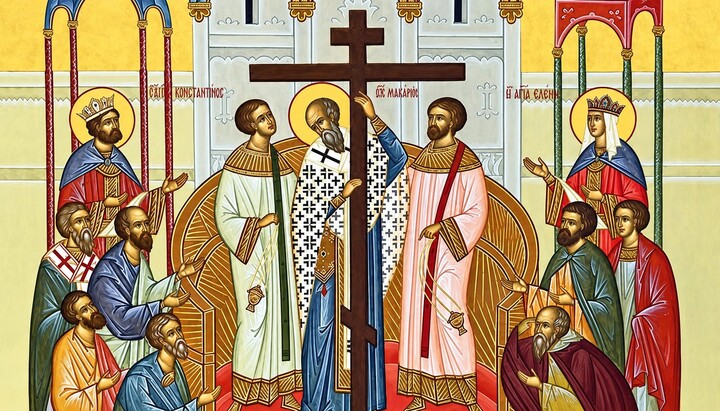
Icon of the Exaltation of the Holy Cross. Photo: sppsobor.by
On September 27, the Orthodox Church celebrates one of its twelve Great Feasts – the Exaltation of the Precious and Life-Giving Cross of the Lord. The feast commemorates the discovery of the Holy Cross in the fourth century and its solemn return from Persian captivity in the seventh century.
Following the Savior’s redemptive sacrifice, Resurrection, and Ascension, the instrument of His execution remained hidden for many years. After the Romans destroyed Jerusalem in AD 70, the holy sites associated with the Lord’s earthly life fell into neglect, and pagan temples were erected over them.
The discovery of the Cross took place during the reign of Emperor Constantine the Great. His mother, St. Helena, Equal-to-the-Apostles, traveled to the Holy Land in search of the sites of Christ’s Passion.
Beneath a demolished pagan temple, three crosses were discovered, along with nails and a plaque bearing an inscription. To identify the Savior’s true Cross, each was placed in turn upon a sick woman, who was instantly healed upon contact with one of them.
Countless Christians gathered to venerate the Holy Cross and asked St. Macarius, Bishop of Jerusalem, to raise it high so that everyone might behold it reverently, even from afar. The bishop and other clergy then lifted the Holy Cross aloft, while the people bowed before the Precious Wood, crying out, “Lord, have mercy!”
In the seventh century, the commemoration of the Cross’s discovery was joined by the remembrance of its return from Persia. In 614, Persian forces sacked Jerusalem and carried off the sacred relic. Fourteen years later, Emperor Heraclius defeated the invaders and returned the Cross to Jerusalem, where it was once again solemnly elevated for the faithful to glorify.
On this day, Orthodox churches celebrate the solemn Divine Liturgy, during which the Gospel account of the Savior’s suffering and death is read. The Holy Cross is brought out to the center of the church as troparia and hymns of praise are sung.
The feast unites joy and triumph in the glorification of Christ and the instrument of redemption, through which humanity received salvation, with prayerful sorrow over the Savior’s death on the Cross. The Cross is both the banner of victory over sin and the altar upon which the sinless Lamb willingly suffered for the salvation of the world. The strict fast observed on this feast each year serves as a reminder of this profound mystery.
As the UOJ previously reported, His Beatitude said that Christ conquered human malice through love on the Cross.
Read also
Wounded Catholic priest in Poland calls to forgive Ukrainian attacker
A Catholic priest wounded in the attack on a Benedictine abbey in Jarosław asked the faithful to pray for the attacker and not blame the Ukrainian people as a whole.
UOC begins celebrations honoring St. Kuksha of Odesa
A service on the eve of the feast day of St. Kuksha of Odesa was held at the Dormition Monastery.
Kyiv-Pechersk Lavra Reserve raises concern over Sviatohirsk shrines
Exhibition organizers stressed the need to document the impact of the war on Sviatohirsk in order to preserve Ukrainian identity.
Favor Foundation donates food and diapers to Kharkiv hospital
The UOC charity provided hygiene supplies for patients at an emergency hospital in Kharkiv.
Dumenko presents awards to staff ahead of Soviet-era Reserve’s anniversary
The OCU claimed that the creation of the Soviet museum made it possible to preserve the Kyiv Caves Lavra during the years of atheist persecution.
UOJ-USA publishes scandalous Phanar document about chronicles of OCU creation
In the document prepared for Patriarch Bartholomew, a Phanar representative described the SBU's surveillance of the Constantinople delegation and Poroshenko's pressure on the course of the "Unification Council."